
3D digit sums: the same total does not mean the same result
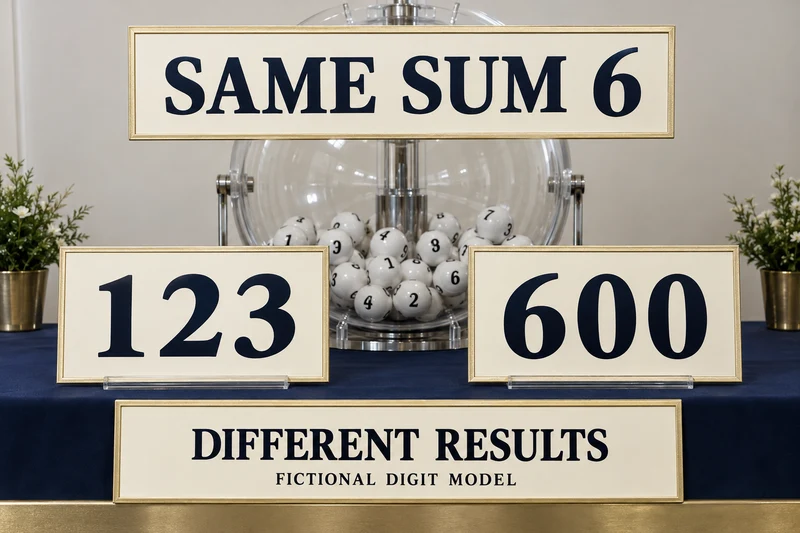
123 and 600 both have a digit sum of 6, but they are different three-digit results. A sum chart groups results into categories. It does not retain the exact sequence or identify an accepted entry.
This guide in the playtime lottery section uses a fictional ordered three-digit model to make that distinction visible. The example is a mathematical grouping exercise, not a number recommendation or a real product’s prize rule.
A calculated total discards information
The digit sum of 123 is 1 + 2 + 3 = 6. The sum of 600 is 6 + 0 + 0 = 6. Their shared total says only that the three digits add to the same number. It does not say the digits are the same, that their order is the same, or that either result qualifies for an actual entry.
Even 123 and 321 share the same total while retaining different ordered sequences. Preserve the original three-digit string in one field and the derived sum in another. Keep leading zeros: 006 has sum 6 but remains the three-position sequence 006, rather than a one-digit result.
Count the complete sequences inside one sum category
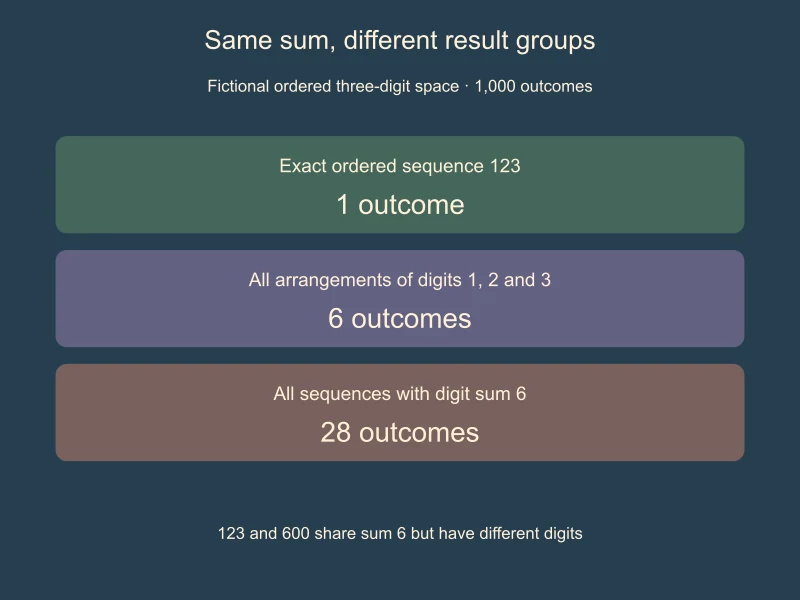
Assume three ordered positions independently take digits 0 through 9 with equal probability. Repetition and leading zeros are allowed. The space contains 1,000 equally likely sequences. In this model, exact result 123 is one of those sequences, with probability 1/1,000.
The event “digit sum is 6” contains 28 different sequences. They can be grouped by their digit contents before counting each group’s distinct arrangements. This table covers the whole sum-6 category:
| Digits grouped without order | Distinct ordered arrangements | Count |
|---|---|---|
| 0, 0, 6 | 006, 060, 600 | 3 |
| 0, 1, 5 | 015, 051, 105, 150, 501, 510 | 6 |
| 0, 2, 4 | 024, 042, 204, 240, 402, 420 | 6 |
| 0, 3, 3 | 033, 303, 330 | 3 |
| 1, 1, 4 | 114, 141, 411 | 3 |
| 1, 2, 3 | 123, 132, 213, 231, 312, 321 | 6 |
| 2, 2, 2 | 222 | 1 |
The counts sum to 3 + 6 + 6 + 3 + 3 + 6 + 1 = 28. The broad sum-6 event therefore has probability 28/1,000 = 2.8% under the assumed model. It includes 123, but it is not the probability that an exact 123 entry matches.
Permutations and equal sums are different groups
The six arrangements of digits 1, 2 and 3 all have sum 6. They do not exhaust the sum-6 category: the other 22 sequences use different digit contents. Conversely, grouping by sum does not tell you how many arrangements a particular three-digit string has.
The existing guide to distinct permutations with repeated digits explains why a fixed set of digits can have six, three or one arrangement. Use that distinction before labelling a list. “All permutations of 123” and “all sequences with sum 6” are not interchangeable captions.
Sum categories are not equally large
There are 28 possible sum values, from 0 through 27. That does not make each sum’s probability 1/28. Sum 0 occurs only for 000; sum 27 occurs only for 999. Each of sums 13 and 14 occurs in 75 sequences in the assumed space.
Those broader categories are more likely than the one-sequence categories because more complete sequences map to them. It does not make any one sequence in a category more likely than another exact sequence. Under the stated equal-likelihood model, every exact string still has probability 1/1,000.
OpenStax’s discrete-distribution explanation gives two basic checks: each probability lies between zero and one, and the full distribution sums to one. We apply those checks to our own enumerated sum categories. The source does not provide these lottery counts or verify a real draw system.
A historical sum chart is another dataset
Counting sums in a collected archive measures the records in that archive. It is not automatically the same as enumerating a theoretical space. Keep product, draw identities, missing records and duplicate rows visible before making a historical histogram.
If one sum appears rarely in a small archive, that observation does not establish that it is due next. The theoretical counts here depend on the independent-uniform-digit assumptions, which have not been verified for any actual operator.
Keep the derived field’s purpose beside it
A clear example note is “original sequence 123; calculated digit sum 6; fixed-digit permutations 6; all possible sum-6 sequences in the assumed model 28.” Each value has a different role. None states a payout, accepted entry type or prize entitlement.
Source and exhaustive enumeration checked on 10 October 2026. This guide helps a reader interpret a grouped chart without losing the original result. It provides no forecast or advantage for choosing numbers.