
GUIDE · playtime
Queenie: why a win cap can end a bonus with spins left
A bonus counter does not always have to reach zero before a feature ends. Queenie’s published rules include a maximum-win stopping condition: reaching the cap ends the feature even if free spins remain.
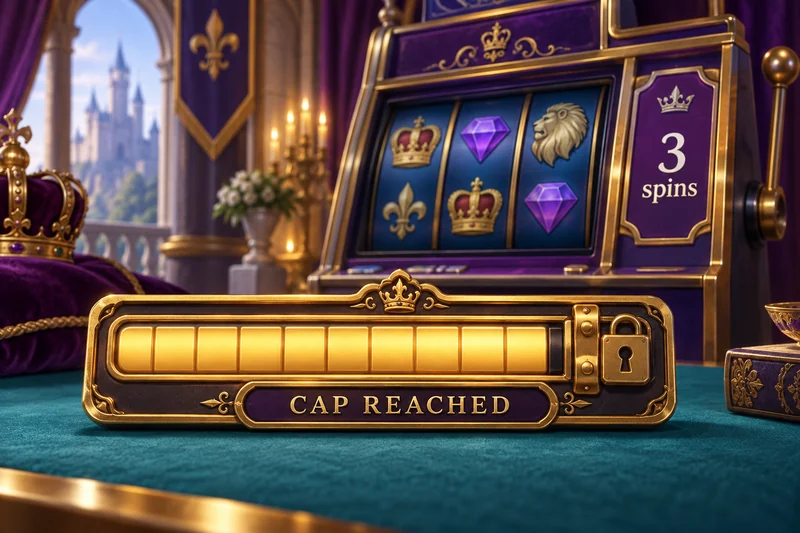
The counter and the stopping rule answer different questions
The Queenie game overview, checked on 8 October 2026, lists a maximum win of 4,200 times the bet and says the feature ends when that limit is reached, forfeiting remaining free spins. The document supports that stopping condition; it does not establish what happened in any particular account.
A counter tells you how many scheduled spins remain under ordinary continuation. A cap defines a separate limit on that continuation. Reading the counter while ignoring the stopping rule leaves out a condition that can explain an apparently early finish.
A small cap model makes the arithmetic visible
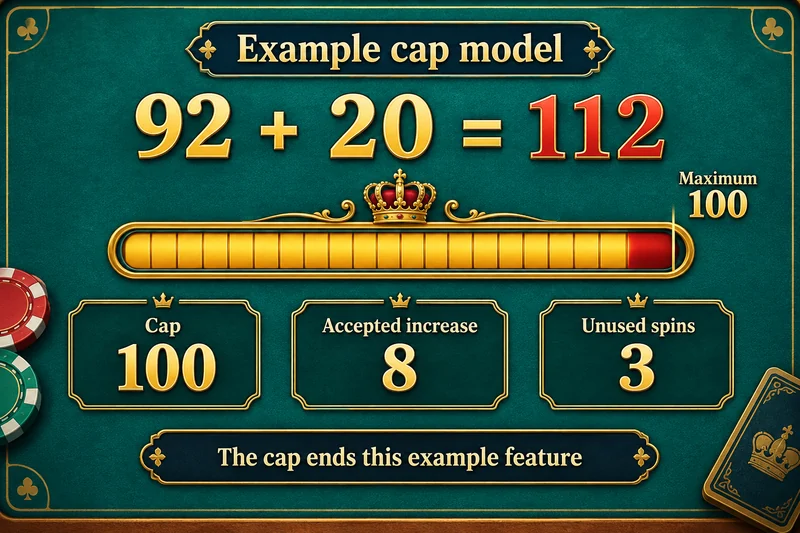
Here is an invented example using a 100-unit cap so the accounting is easy to follow. It is not Queenie’s actual cap or a game-session record. Assume the accepted feature total cannot exceed 100 and that reaching it ends the example feature.
| Item | Example value |
|---|---|
| Total already accepted | 92 |
| Next nominal award before the cap | 20 |
| Uncapped sum | 112 |
| Accepted total under the assumed cap | 100 |
| Increase accepted at this point | 8 |
| Spins still shown before termination | 3 |
The calculation is min(92 + 20, 100) = 100. The accepted increase is 100 − 92 = 8. Under the assumptions, adding another 20 to 100 or projecting three further awards would ignore the cap that ended the example.
Unused spins are not a known missing amount
“Three spins remained” is a count of unplayed events. It is not evidence that each event would have paid a particular sum. Multiplying those spins by a recent award invents outcomes that did not occur.
There is also a difference between an early finish described by the rules and an unexplained interrupted round. A frozen screen alone does not prove a cap was reached. To distinguish them, you need the applicable cap basis, final accepted total, feature status and round reference. Keep a pending result pending until the history actually records a final state.
Keep the original feature award in context
The number of spins originally awarded is useful evidence, but it must be read with all end conditions. The spin-count and wheel-multiplier guide explains why separate feature quantities should not be merged. A cap adds another separate field: the maximum permitted result for the relevant scope.
For a real discrepancy, a concise question is: “Which cap applied to this round, what total did it use, and did that rule close the remaining spins?” That is more precise than assuming the counter guarantees a cash value. No further play is needed to formulate the question.
This is a rule-reading explanation, not a reason to pursue a maximum. Find other examples in the slot mechanics section or through the playtime homepage.
Source-based editorial research and original examples. Sources checked 2026-10-08.